


People of the road – Travellers in Drenthe
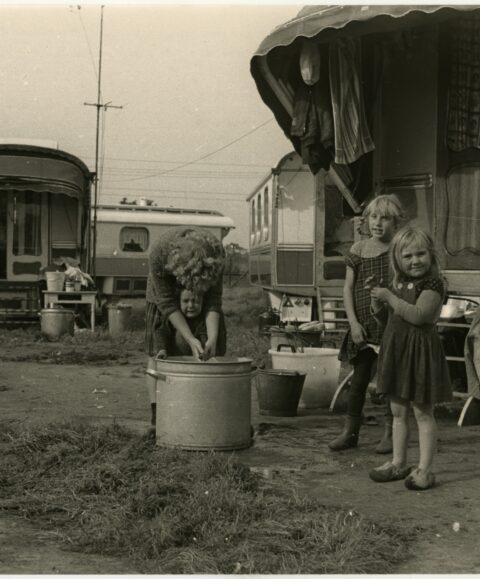
- 16 March till 2 November 2025
- Drents Museum
From 16 March, the Drents Museum will present People of the road – Travellers in Drenthe.
In the exhibition you will get to know caravan dwellers from Drenthe across different periods. From pedlars to seasonal workers and from P. Kremer, who drove his caravan into Assen in 1876, to well-known contemporary travellers, such as football coach Joseph Oosting from Emmen.
We have created this exhibition in collaboration with travellers from Coevorden, Emmen and Hoogeveen. People of the road – Travellers in Drenthe tells the story of travellers in three chronological parts: from the arrival of the first migrant workers, pedlars and craftsmen, through the time when travelling with caravans was commonplace, to the world of today's travellers. Attention is also paid to the Sinti and Roma.
Along the Lord's roads
Many people think that our ancestors were very sedentary. That image is not correct. For centuries, people have travelled across Drenthe in search of work or trade. Part of the exhibition People of the road – Travellers in Drenthe deals with the important role played by migrant labour and itinerant trade in Drenthe since the late Middle Ages.

The Drents Museum has created the exhibition in collaboration with a group of travellers from Drenthe. Annie Veenstra-Hendriks from Coevorden comes from a family with a large recycling company. Marie Smit, Nicole Bakker and Harmanda van Veen have been campaigning for more caravan sites in Emmen for years with their working group De Rolleman. Jan Bauer sits on the municipal council in Hoogeveen. Here, he champions the interests of caravan dwellers on housing and social issues, among other things. Together with the other members of the People of the road working group, he and his father Bart have contributed to the content and set-up of the exhibition.
Living on wheels
As more and more roads were paved in the 19th century, the caravan made its appearance. The caravan was a lot more comfortable to travel with and made it possible to take the whole family along. The exhibition People of the road – Travellers in Drenthe paints a picture of the first caravan dwellers. Special attention is paid to the fate of travellers and the Sinti and Roma during the Second World War.

The caravan feeling
Finally, the exhibition introduces you to Drenthe travellers of today. Two Drenthe filmmakers went in search of 'the caravan feeling' in a series of personal interviews. What are the travellers proud of, what unites them and how do they see their future? The visitor gets a glimpse into the world of Drenthe travellers.
Travellers in perspective
The Drents Museum is making a podcast for the exhibition and a book will be published in collaboration with Waanders publishers. In the book, People of the road – Travellers in Drenthe, curator Jan van Zijverden of the Drents Museum and researcher Hilde Boelema of the Drents Archief examine assumptions about caravan dwellers from a historical perspective and paint a picture of the lives of travellers in Drenthe at different times. An authentic caravan built by students from the Alfa College will also travel through Drenthe, just as it did before the introduction of the Caravan Sites Act in 1968.
Exhibition texts
The most important texts in this exhibition are offered in two languages: Dutch and English. The texts that tell you more about the objects are available online. You can read these from your phone.
There is a QR code in the exhibition space that will take you to the text and you can also find them via the link below.
Visit
Discover this exhibition in real life. Buy your tickets for the Drents Museum now.
Most of the museum is easily accessible for people with reduced mobility. Most floors are accessible by elevator and there are wheelchair-accessible toilets. The museum has free wheelchairs, walkers and folding stools for anyone who wants to use them. Unfortunately, part of the monumental section of the museum is less accessible.
Because of the number of wheelchairs and walkers being limited, you can reserve them via +31 (0)592 - 377 773.
More information about the accessibility of the building can be found here.
Supervisors (on presentation of a public transport companion card) and registered assistance and guide dogs are of course very welcome and can enter the museum free of charge.
The Drents Museum always has a number of changing exhibitions and we also have a rich collection of our own. You can visit our own collection in our new collection presentation Labyrinthia.
All current exhibitions and presentations can be found on the exhibitions page.
More and more objects can also be found online. Learn all about your favorite object and discover new treasures!
Registered assistance or guide dogs are welcome in the museum, other pets are not.
Brasserie Pingo can be found in the heart of the old museum section. Pingo's opening hours are the same as the museum, from Tuesday to Sunday between 10 a.m. and 5 p.m. Here you can drink coffee and eat cake, however salads, sandwiches and appetizers are also on the menu.
Related pages
-
The Largest Doll’s House in the Netherlands
![]()
-
Menyala (online exhibition)
![]()
-
DMspotlight - Wilhelmina Proos
![]()
-
Christoph Ruckhäberle - The fourth wall
![]()


