


Martin Roemers
- 25 March till 17 June 2018
- Drents Museum
Kabul Portraits
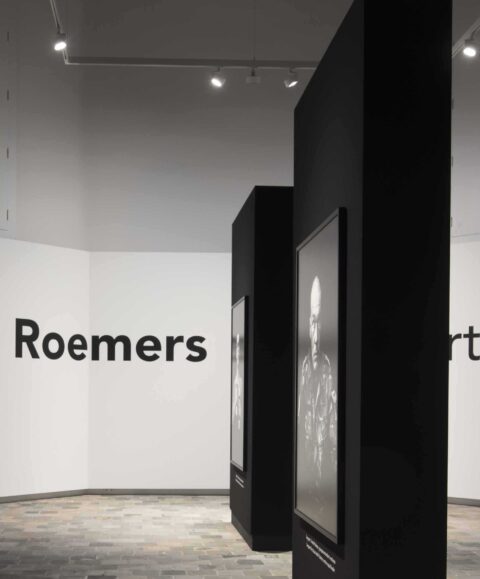
In 2002 photographer Martin Roemers (1962) shot a series of portrait photographs of Dutch soldiers stationed in Afghanistan who came from the Johan Willem Friso Barracks in Assen. The portraits acquired an extra dimension because they were taken with an antique camera that he borrowed from a street photographer in Kabul. With his Kabul Portraits, Roemers has created a timeless series of photographs of soldiers devoid of all frills. The Drents Museum is presenting fourteen of these penetrating large-format portraits in the exhibition Martin Roemers - Kabul Portraits, Dutch soldiers in Afghanistan, on view through 17 June 2018.
The photographer Martin Roemers had worked on numerous projects about the long-term effects of wars and conflicts. In 2002 the Dutch Army Museum in Delft gave him carte blanche to document the Dutch troops in Afghanistan at his own discretion. The soldiers were part of ISAF, the international military force charged with maintaining security in Kabul after the fall of the Taliban.
Developed on the spot
Roemers made the photographs in a singular way. He happened to run into photographers in a square in Kabul who worked with antique box cameras and produced passport photographs in a highly unusual manner. Roemers adopted this procedure for his own series. He borrowed a camera from a local street photographer, created a makeshift open-air studio on the NATO base, and selected soldiers for their faces and personality.


He then had the sitters pose motionless for ten seconds – the exposure time for each photograph – after which the portraits were developed on the spot by the Afghan photographer. The result is a gritty series full of imperfections, spots and scratches, but also full of gravity.
The consequences of wars and conflicts
Martin Roemers (1962) grew up in Assen and studied at the AKI Academy of Fine Arts in Enschede. He has an extensive international oeuvre to his name and exhibits all over the world. He has produced eight photography books, including Kabul. Dutch troops in Afghanistan. His work is found in the collections of the Rijksmuseum in Amsterdam, Huis Marseille - Museum for Photography in Amsterdam, the Deutsches Historisches Museum in Berlin, and the Museum of Fine Arts in Houston, Texas. The New York Times, The Wall Street Journal, The New Yorker, National Geographic Magazine and many other periodicals have reviewed him and his work. Roemers is represented by galleries in Amsterdam, Dubai, Paris, and New York.
Visit
Discover this exhibition in real life. Buy your tickets for the Drents Museum now.
Most of the museum is easily accessible for people with reduced mobility. Most floors are accessible by elevator and there are wheelchair-accessible toilets. The museum has free wheelchairs, walkers and folding stools for anyone who wants to use them. Unfortunately, part of the monumental section of the museum is less accessible.
Because of the number of wheelchairs and walkers being limited, you can reserve them via +31 (0)592 - 377 773.
More information about the accessibility of the building can be found here.
Supervisors (on presentation of a public transport companion card) and registered assistance and guide dogs are of course very welcome and can enter the museum free of charge.
The Drents Museum always has a number of changing exhibitions and we also have a rich collection of our own. You can visit our own collection in our new collection presentation Labyrinthia.
All current exhibitions and presentations can be found on the exhibitions page.
More and more objects can also be found online. Learn all about your favorite object and discover new treasures!
Registered assistance or guide dogs are welcome in the museum, other pets are not.
Brasserie Pingo can be found in the heart of the old museum section. Pingo's opening hours are the same as the museum, from Tuesday to Sunday between 10 a.m. and 5 p.m. Here you can drink coffee and eat cake, however salads, sandwiches and appetizers are also on the menu.
Related pages
-
DMspotlight - Wilhelmina Proos
![]()
-
Labyrinthia
![]()
-
Christoph Ruckhäberle - The fourth wall
![]()
-
Menyala (online exhibition)
![]()


