


Angkor – The mystery of Cambodia
- 17 October 2026 till 9 May 2027
- Drents Museum
-
Accessibility -
Tickets
The world's largest religious monument is on display in Europe for the first time.
More than one hundred original objects from the famous city of Angkor will be on display at the Drents Museum in Assen from 17 October 2026. While Angkor is best known for its atmospheric tourist images and its appearance in the Dutch television programme Wie is de Mol?, there is much more to this architectural wonder. Eight hundred years ago, Angkor was the largest city in the world, before its golden age came to an end. The story of this UNESCO World Heritage site occupies an important place in world history and remains highly relevant today. Making its European debut, the exhibition combines centuries-old history with archaeological discoveries, interactive elements and contemporary themes such as heritage conservation and the impact of biased historical narratives.

Angkor is one of the most important archaeological sites in Southeast Asia. Its temples are the national symbol of Cambodia, with Angkor Wat – the largest religious monument in the world – prominently featured on the country's flag. With an estimated population of 750,000 and covering an area of around 1,000 square kilometres, roughly four times the size of present-day Amsterdam, Angkor was the capital of the Khmer Empire and the largest city in the world during the twelfth and thirteenth centuries. Today, Angkor remains both a major pilgrimage site and one of Southeast Asias most popular tourist destinations. Its temples have been in continuous use for more than a thousand years.
Masterpieces of Khmer Art
The exhibition features 120 original objects from Cambodia, including Buddhist and Hindu sculptures and religious artefacts from Angkor dating from the ninth to the fifteenth centuries. Sanskrit and Khmer inscriptions, which provide valuable insights into the empire’s rulers and frontier regions, also form part of the exhibition. In addition, the museum presents nineteenth- and twentieth-century archival material.
Highlights include a portrait of King Jayavarman VII, regarded as one of the masterpieces of Khmer art, a lintel depicting scenes from the life of Buddha, and an elephant bell. Videos and interactive displays bring visitors closer to Cambodia’s rich culture and landscape.

Asura head, Gate of Angkor Thom
Siem Reap, 13th century

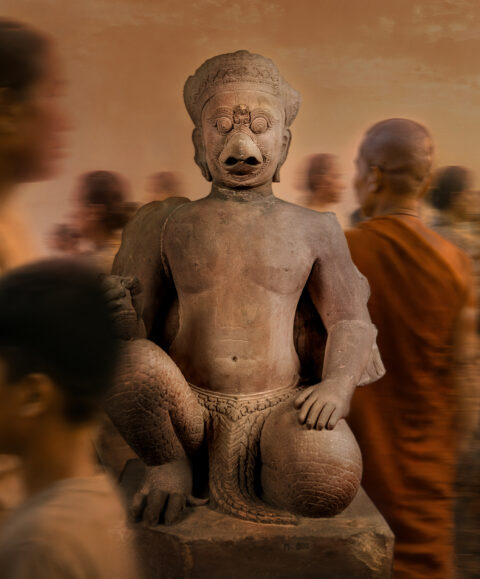
Garuda guardian, Banteay Srei
Siem Reap, 10th century

Portrait of Jayavarman VII, Preah Khan of Kompong Svay
Preah Vihear, 12th–13th century

Elephant bell, Wat Sangke, Sangke
Battambang, 12th–13th century

Shrine with Hevajra, Prei Monti, Roluos
Siem Reap, late 12th – early 13th century

Ganesha, Banteay Chhoeu, Puok
Siem Reap, 12th–13th century

Vaisnava boundary marker, Wat Khnat, Puok,
Siem Reap, ca. 12th–13th century

Lintel with scenes from the life of the Buddha
First half of the 12th century
‘A European first for the Drents Museum with an exhibition on the world-famous temple city of Angkor’

Catalogue
The catalogue Angkor – The Mystery of Cambodia has been published to accompany the exhibition. International scholars explore the history and archaeology of Angkor, revealing how innovative research techniques are transforming our understanding of this ancient city. Lidar technology, for instance, has provided new insights into the scale and urban layout of Angkor and its advanced water management system. The catalogue was produced in collaboration with Waanders Publishers.
Angkor – The Mystery of Cambodia is available in our Museumshop for €29.95.

Want to know more?
Sign up for our (Dutch-language) newsletter to stay up to date with the latest news about our museum.
The exhibition is a cooperation with MUSEUMsPARTNER, the National Museum of Cambodia (NMC), the EFEO and the California Science Center.
The surroundings in the campaign image were created using AI-generated images. The statue shown is the original and has not been altered using AI.
For press
For questions, the press can contact marketing and communications, Ayana Emmens (a.emmens@drentsmuseum.nl).
Our partners


Visit
Discover this exhibition in real life. Buy your tickets for the Drents Museum now.
Adults pay €17,50 for a ticket, unless there is an exhibition change. In that case, an adult ticket costs €12.50. Children up to 18 years of age have free admission. In case of some exhibitions, an additional charge is applied, this is the case for the Angkor exhibition. Click here for a full overview of our current prices.
Angkor is one of the most important archaeological sites in South-East Asia. The temple city is a UNESCO World Heritage Site and plays a significant role in world history. For these reasons, we at the Drents Museum wish to tell the story of Angkor in the Netherlands as well. This is the first time this has been done in Europe.
With the proceeds from, amongst other things, ticket sales and the museum shop, we can bring exhibitions and their accompanying programmes to life. In some cases, the standard admission fee alone is not sufficient to cover the costs. This is the case with Angkor. To avoid having to increase the standard admission fee, we are asking the public for a specific additional contribution in the form of a surcharge for this exhibition.
No, if you visit the Drents Museum again whilst the Angkor exhibition is running, you won’t need to pay the surcharge again. On your first visit, ask at the ticket office for a sticker as proof that you have already visited the exhibition; you can show this on your next visit.
Guided tours through the Drents Museum are possible for groups of 10 people or more. Book your tour here.
Related pages
-
The Largest Doll’s House in the Netherlands
![]()
-
Shivangi Kalra - With my eyes closed
![]()
-
Labyrinthia
![]()
-
Menyala (online exhibition)
![]()


