


Amrita Sher-Gil ‘Europe belongs to Picasso, India belongs to me’
- 14 May till 20 September 2026
- Drents Museum
The long-awaited exhibition Amrita Sher-Gil – “Europe belongs to Picasso, India belongs to me” has opened. Seize this unique opportunity to view the paintings of artist Amrita Sher-Gil from the collection of the National Gallery of Modern Art in New Delhi.
Renovation Works
Construction work will be taking place on the museum’s south façade from 15 to 18 September. The work will be carried out on the exterior of the building, but visitors in the Singelzaal gallery may experience some disturbance. We will do our best to keep any inconvenience to a minimum and thank you for your understanding.

‘Europe belongs to Picasso, Matisse, Braque, and many others. India belongs only to me.’ With these words, Amrita Sher-Gil (1913–1941) described her unique position in the art world. She is regarded as the founder of modern Indian art.
In this exhibition, we will present photos of and paintings and drawings by the Hungarian-Indian Amrita Sher-Gil (Budapest 1913 – Lahore 1941). She lived only 28 years, but left behind an impressive and influential body of work. Yet outside of India, Amrita Sher-Gil is still relatively unknown to the general public. This may also be due to the fact that her work has very rarely left India. The last time her art was shown in Europe was nearly twenty years ago.
‘‘Europe belongs to Picasso, Matisse, Braque, and many others. India belongs only to me.’’

Amrita Sher-Gil, 'Young Girls', Paris, June 1932

Amrita Sher-Gil, 'Winter', Zebegény (Hungary), January 1939

Amrita Sher-Gil, 'Three Girls', Amritsar (India), January 1935

Amrita Sher-Gil, 'Sumair', Saraya (India), 1936

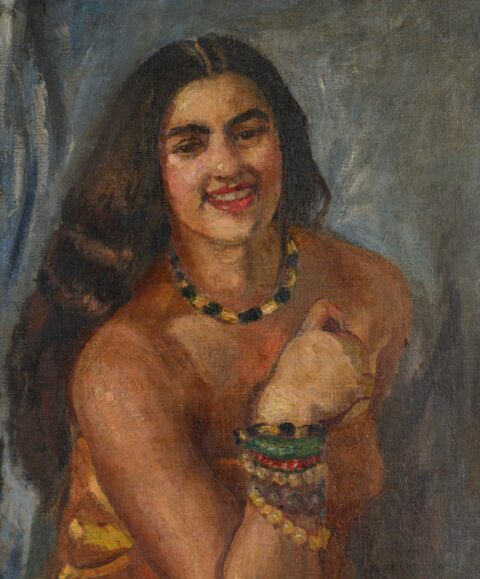
Amrita Sher-Gil, 'Self-Portrait', Paris, circa 1930

Amrita Sher-Gil, 'Department store', Parijs, 1933
‘It seems to me that I never began painting, that I have always painted. As I have always had, with a strange certitude, the conviction that I was meant to be a painter and nothing else.’
Young years
India was her father’s country; Hungary was her mother’s. Amrita Sher-Gil was born in Budapest in 1913 and grew up between two cultures. From an early age, she proved herself to be creative, free-spirited and independent. She took drawing and painting lessons and began pushing boundaries at a young age. In 1924, she briefly attended art school in Florence, where she became acquainted with the Italian masters, but she was almost expelled for drawing nude portraits.
Paris
In 1929, Sher-Gil left with her family for Paris to study at the Académie de la Grande Chaumière and later at the prestigious École des Beaux-Arts. There, she immersed herself in the work of modern artists such as Suzanne Valadon, Paul Cézanne and Paul Gauguin. She painted numerous self-portraits, as well as friends, scenes of Parisian life and still lifes. Her talent did not go unnoticed: in 1933, she won the gold medal at the Salon de Paris with her painting Young Girls. She was also elected a member of this prestigious society – the youngest artist ever to receive this honour and the first of Asian descent. In Paris, she developed into a cosmopolitan painter who effortlessly connected different worlds.
‘My professor had often said that judging by the richness of my colouring, I was not really in my element in the grey studios of the West, that my artistic personality would find its true atmosphere in the colour and light of the East.’
India
In 1934, Amrita Sher-Gil returned to India, convinced that her destiny lay there. She built upon European painting traditions, enriching them with elements from traditional Indian art. She exchanged her European clothes for saris and travelled across the country. She found inspiration in, among other things, the cave paintings of Ajanta, Mughal miniatures, and everyday life in markets and villages. Her colour palette changed dramatically: vivid reds, earthy browns and warm ochres reflect the Indian light and landscape. In her work, she introduced a new and powerful image of womanhood and gave a voice to India’s poor and marginalised communities.
‘I began to be haunted by the intense longing to return to India, feeling in some strange inexplicable way that there lay my destiny as a painter.’


↑ Amrita Sher-Gil, Self-Portrait, Parijs circa 1930 → Amrita Sher-Gil, Haldi (turmeric) Grinders, Saraya (India), circa 1940
Unique exhibition
Amrita Sher-Gil – ‘Europe Belongs to Picasso, India Belongs to Me brings together paintings and drawings on loan from the National Gallery of Modern Art in New Delhi, which holds the largest and most comprehensive collection of her work. The exhibition traces her development, from her Parisian period to the works in which she captures the strength and beauty of everyday life in India.
Her paintings are regarded as national treasures and therefore rarely leave India. This exhibition offers a unique opportunity to view her masterpieces up close.

Visit
Discover this exhibition in real life. Buy your tickets for the Drents Museum now.
Most of the museum is easily accessible for people with reduced mobility. Most floors are accessible by elevator and there are wheelchair-accessible toilets. The museum has free wheelchairs, walkers and folding stools for anyone who wants to use them. Unfortunately, part of the monumental section of the museum is less accessible.
Because of the number of wheelchairs and walkers being limited, you can reserve them via +31 (0)592 - 377 773.
More information about the accessibility of the building can be found here.
Supervisors (on presentation of a public transport companion card) and registered assistance and guide dogs are of course very welcome and can enter the museum free of charge.
The Drents Museum always has a number of changing exhibitions and we also have a rich collection of our own. You can visit our own collection in our new collection presentation Labyrinthia.
All current exhibitions and presentations can be found on the exhibitions page.
More and more objects can also be found online. Learn all about your favorite object and discover new treasures!
Registered assistance or guide dogs are welcome in the museum, other pets are not.
Brasserie Pingo can be found in the heart of the old museum section. Pingo's opening hours are the same as the museum, from Tuesday to Sunday between 10 a.m. and 5 p.m. Here you can drink coffee and eat cake, however salads, sandwiches and appetizers are also on the menu.
Related pages
-
Antonio López (online exhibition)
![]()
-
Shivangi Kalra - With my eyes closed
![]()
-
Angkor - The mystery of Cambodia
![]()
-
Jan van der Kooi - Tomorrow I will make my best work
![]()


